Anna Ornstein, MD, psychiatrist, and psychoanalytic Self Psychologist, is remembered and honored as a Holocaust survivor, having been incarcerated in Auschwitz with her mother in 1944 when the Germans invaded Hungary. Her experiences are narrated in her book, My Mother’s Eyes: Holocaust Memories of Young Girl (2004). Both survived. Anna Ornstein passed away at her home in Brookline, MA at the age of 98 on July 3, 2025 after a rich, challenging, and dynamic life.
Trying to say anything about such searing experiences is perhaps foolish, yet Ornstein’s next major contribution provides the tool to do so in so far as it can be attempted at all. Ornstein is remembered and honored for making empathy central in her clinical practice of psychoanalytic psychotherapy and in her writings on the Self Psychology (more on which shortly). One of the things that empathy teaches us humans is to try to bring words to one’s experiences, no matter how challenging the experiences; try to find words to push back the boundaries of the inexpressible, that which is not to be comprehended. Cognitive understanding should never be underestimated; yet at times cognition is illusive and overrated whereas communication is not, empathy is not, family is not, community is not.
Though starting as a collection of anecdotes and narratives of survival, the title, My Mother’s Eyes, takes the account up a level. As a 17-year-old teenager, incarcerated with her mother and allowed to be together, the survival value of being able to change perspectives – the folk definition of empathy – was critical path to surviving the rigors – the horrors – of death camp life. Even under very challenging circumstances, people are able to support one another emotional regulation by literally being there for another as a comforting presence. The relationship in this extreme situation prefigures the notion of self object, making use of the other person mutually to regulate one another’s emotions. It is the other’s presence that, with a nod to D. W. Winnicott, provides a grounding in the radical possibility of going on being.
This essay is in the nature of an intellectual biography and personal anecdote, rather than an obituary proper. For those interested in how Anna née Brünn met Paul Ornstein and become Anna Ornstein, how all three of their children became psychiatrists, the New York Times articles provides the personal details and a happy, though by no means simple, ending to the catastrophe of the Holocaust and World War II.[1]
On a personal note, my path and that of Anna Ornstein intersected with what can best be described as an existential encounter in 2009. Something called “Self Psychology” was disrupting classic psychoanalysis and innovating around the constraints of Freudian ego psychology. The Self Psychology Conference was in Chicago that year (2009, the full title “International Assoc for Psychoanalytic Self Psychology”).[2] In any case, there were many high points to the Conference including Dr. Arnold Goldberg’s presentation and those of other Self Psychology innovators such as Ernest Wolf, Anna and Paul Ornstein, the Kohut Memorial Lecture, the many spirited exchanges.
The highest of the high points of the Conference came for me in having a one-on-one conversation with Anna Ornstein. There she was between presentations, and I introduced myself as working on a book about empathy, which did indeed get her attention. In a naïve, misguided attempt on my part to establish common ground, I mentioned that I had attended the lectures at the UChicago on the life of the mind by the political theorist Hannah Arendt. I also quoted Arendt to the effect that since the consequences of our human actions escape us, Jesus of Nazareth had innovated in the matter of forgiveness. Star struck, what was I thinking? This was clumsy and naïve on my part, and it got a reaction which was perhaps more than I had bargained for. In the course of the conversation, Ornstein took my hand animatedly and held it as she was making her point, basically that Arendt had gotten matters wrong, very wrong. When I say “took my hand,” I mean she grabbed it and shook it back and forth, not exactly like shaking hands, but like she would wrestle me to the ground. To be sure, it was good natured enough, but intense. The take-away? I got to hold hands with Anna Ornstein! Notwithstanding my clumsiness, that was special. I cherish the encounter.
Now in a short piece such as this, doing justice to Anna Ornstein’s innovations in self psychology (the method not the label), especially the treatment of children, is no simple task. People want to read about tips and technique, and many are available. However, context is required.
On background, Heinz Kohut, MD, was the innovator who put self psychology and empathy on the map starting in the early 1970s (though see Kohut 1959). Kohut was cautious about defining the self formally, implicitly characterizing the self as a comparative experience—a near experience psychoanalytic abstraction, that is central to all human experience since it contains the person’s nuclear ambitions and ideals which are amalgamated to the sense of continuity (Winnicott’s “going on being”), the well-being and cohesion of (our) body and mind (Ornstein 1976: 29ftnt).
Thus, the self oscillates dynamically between ideals and coherence, both of which are needed for a sense of aliveness, vitality, and an actual ability to be productive in contributing to community and relationships with others. Kohut’s (1959) definition of empathy as “vicarious introspection” adds significantly to the folk definition of taking a walk in the other person’s shoes, the better to appreciate the other’s struggles and successes as the person experiences them. (For further on Kohut’s innovation see the book (and chapter devoted to Kohut) to which I referred in my conversation with Ornstein in our encounter (Agosta 2010).)
While firmly founded in Freudian dynamics, Self Psychology called out how parenting environments that delivered unreliable empathy – not total lack of empathy, but unreliable, hit-or-miss empathy – resulted in structural deficits in self-esteem, self-confidence, productivity, feelings of emptiness, lack of aliveness and vitality, in children as well as the adults into which they grow. This was a deficit model rather than – or in addition to – a conflict model. Instead of conflicts between the conscience (superego) and sexual and aggressive drives, something was missing that left the person’s personality at a disadvantage in the face of which the person compensated with arrogance, superiority, coldness, withdrawal, empty depression (rather than melancholia), and poor productivity and superficial relations.
When the self experiences narcissistic injuries – did not get the dignity, respect, empathy – to which it was entitled or felt entitled (eventually a key distinction, but not at this point), then aggressive and sexually fragmented behavior was the result. In short, maladaptive sexual behavior and hostility are reactions to a stressed-out self rather than primary instinctual drives. So if you encounter a person who is enraged, ask yourself, who hurt that person’s feelings? Who did not give her or him the dignity, respect, empathy, they feel they deserve? Thus, self psychology does not so much reject Freud’s approach as re-describe and incorporate it.
Thus the New York Times article is accurate enough when it writes “Dr. Kohut disagreed with Freud’s theory that personality disorders were rooted in the unconscious mind, driven by guilt, sex and aggression” (Gabriel 2025), provided that one takes “rooted” and “unconscious” in the proper sense. In that sense, the dynamics of Freudian pathology becomes a special case of a fragmented self that has not received the empathy, which, as Kohut famously said, is oxygen for the soul: “The child that is to survive psychologically is born into an empathic-responsive human milieu [. . .] just as he [or she] is born into an atmosphere that contains an optimal amount of oxygen” (Kohut 1977: 85; see also 253). Just as the body goes into rapid decline and arrest without oxygen, so to the human psyche (the Greek word for soul) struggles and cannot sustain itself outside of a context of empathic relations at least somewhere in its life.
For example, the classic Freudian family drama of the child (son) who wants to “kill” the father and “marry” the mother, is redescribed as aggressive and sexual fragments of a self that has experienced unreliable empathy and been the recipient of seductive behavior on the part of the mother and aggressive (defensive) behavior on the part of the father. (For the inverse scenario of father daughter, which deserves attention, too, see Kulish and Holtzman 2008, which, strictly speaking is not self psychology but inspired thereby). In a healthy family dynamic, the father welcomes the young son’s competitiveness, knowing that he (the father) is not threatened by the youngster’s competitiveness. It is only when the father is himself insecure and narcissistically vulnerable that he retaliates punitively, giving way to a reactive hatred on the part of the offspring that Freud projected back into the primal scene as the death drive. For Kohut and Ornstein, aggression and hatred are not primary drives, as with Freud’s death drive, but aggressive and hatred live as reactions to failure of empathy, dignity, and respect. Likewise, the mother welcomes the young boy’s affection and ineffective childish romancing, knowing that the childish behavior is not a serious sexual advance. It is only when the mother, unsecure in herself and her own sexuality, behaves seductively towards the youngster that over arousal of sexuality, over stimulation, boundary issues, family drama, and emotional dis-equilibrium are risked. In the inverse scenario, the father welcomes the young daughter’s affection and childish romancing, appreciating and delighting in the child’s development and growth. This is not a serious seduction – unless the father has unresolved issues. When the father is insecure in his own sexuality and responds seductively to the pretend seduction that the risk of over arousal and real and imaginary boundary violation can occur. The complicating factor in the daughter-mother relationship is that the daughter needs the mother to take care of her – unlike with the son where the hostility between father and son is a purer example of competition – as well as wanting to replace her, resulting in an ongoing ambivalence and competitiveness that is not mirrored in the son’s simple desire to “cancel” the father.
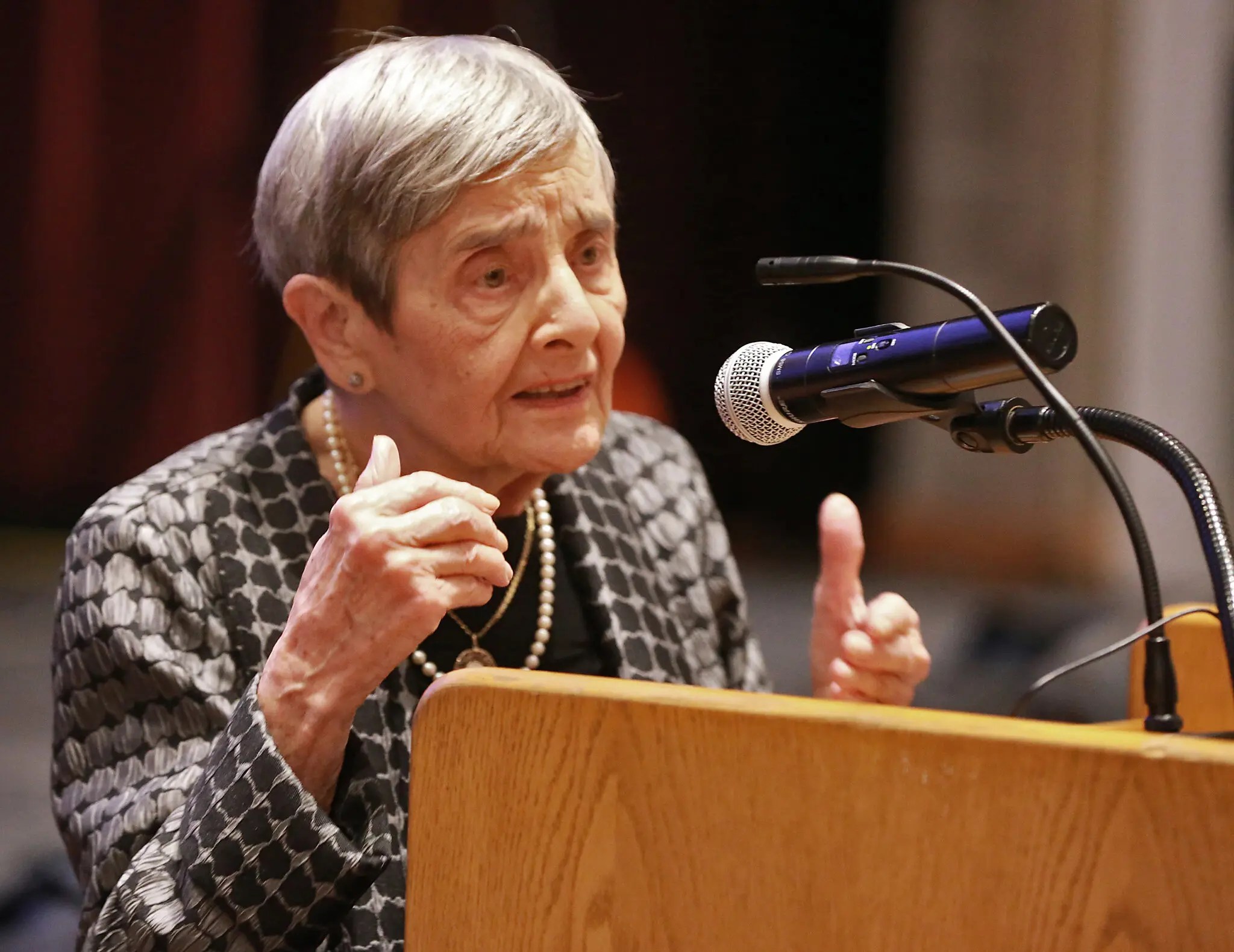
Image / photo credit: Dr. Ornstein in 2018, speaking to high school students in Massachusetts. Credit. Matthew J. Lee/The Boston Globe, via Getty Images
Now shift this conversation in the direction of adult empathy with children, which happens to be the title of a famous article by Christine Olden (1956). When one is in the presence of a child, whether of tender age or teenager, one is present to, aware of, one’s own fate as a child. And since one’s own fate may have little or nothing to do with that which this particular child in this pace and time is experiencing and struggling, that is precisely the point at which expanding the parents’ empathy is on the critical path.
“The parent’s ability to become therapeutic may not have always been optimally utilized in the treatment of children. This is in large part due to a rather pervasive attitude among mental health professionals in which the parents are usually considered at fault, primarily for lacking sensitivity relative to their children’s developmental needs. Anger and depreciation for having failed their children precludes any effort on the therapist’s part to understand the reasons why the parents may not have been able to develop empathic capacities. The explanation for this can usually be found in the parents’ own backgrounds. In addition to the parent’s original difficulties to be in empathic tune with the child, the child’s current difficulties create guilt, anger, and disappointment in the parent(s) which further interfere with whatever parental empathy may have otherwise been available” (Ornstein 1976: 18).
In an example of what not to do, Ornstein cites the following case, in which the empathy toward both parent and child is conspicuous by its absence:
“A young mother had regularly taken her 6-yr-old son to bed with her after the sudden death of her husband. When the boy became enuretic she visited the clinic and was told that the boy had to get out of her bed-since this was the cause of his problem. The mother followed through on the recommendation which meant nightly tearful battles with the child. However, since her own affective state was not “treated,” she could not remove him from her bed without ambivalence. The enuresis continued, and in addition, mother and son became increasingly more irritable with each other. As the mother’s depression deepened, the child developed further symptoms; he had become provocative and inattentive at school” (Ornstein 1976; 18).
Given we have an example of what not to do, what is the recommendation of what one should do in this case? As Ornstein explains (1976: 18), recognize and acknowledge the mother’s grief for her husband and the longing for closeness with the boy. You do not have to lie back on a coach to talk about it, but one might consider doing so! The ability to tolerate the separation between mother and son may usefully have been expanded by a gradual, phased introduction of the separate sleeping arrangements. Having agreed to letting the boy in, summarily throwing him out is surely asking for trouble; yet the co-sleeping cannot continue. Don’t forget that applying common sense parenting is consistent with advanced training and credentials. Many parents have an in-bed “cuddle time” with children of tender age, including a bedtime story, prior to each retiring to his or her own respective nest. “Story time” – whether read or from life – is one possible empathic moment between parent and child in the context of an empathic relationship as the adventures and stresses of the day are empathic quiesced in a narrative before the passive overcoming of going to sleep.
By the way, in the world of behavioral interventions, wise parents know to set the clock for a 2 am trip to “go number one,” which will reduce the stress on child and parent, enabling them to address the underlying issues of loss and separation in a calmer, even if not stress free, context of relatedness.
Often when a therapist meets a family, the family is not on a slippery slope, they are at the bottom of it. The narcissistic slights, emotional injuries, blind spots, shame, guilt, boundary issues, and grievances present a tangle that represents a challenge even to the most astute and empathic therapist. People are motivated to reduce the suffering and struggle, and empathy includes many ways to de-escalate conflict. Ornstein points out:
“To enhance the parents’ therapeutic potentials does not mean to give recommendations as to how to interrupt or actively discourage the child’s disturbing behavior. Particularly destructive are recommendations which ask for changed parental behavior without an appreciation for the parents’ difficulty to comply; such recommendations are “grafted” onto the parents’ pathology. Finding themselves unable to follow the therapist’s recommendations, they become more guilty and less able to effect changes in themselves in relation to the child” (Ornstein 1976: 18).
In the world of tips and techniques, Ornstein did not say “treat the parent; the child gets better”; make bedtime stories an empathic encounter for children of tender age; get inside the world of the child for whom the tooth fairy and boogeyman are real, setting boundaries and soothing in tandem; but she strongly implied them (nor is that the complete solution since the child, too, requires treatment (1976: 18)). One can try and force an outcome; but it is not going to stick; and framing boundary setting in an empathic milieu of acceptance has a much greater probability of producing a positive outcome. This report is acknowledged to be incomplete and further reading can be found in the References.
One caveat must also be offered. It is the same world of limited empathy and human success and suffering today (Q3 2025) as when Anna Ornstein published her innovative work in 1976. However, ours is also a different world. Empathy is a key ingredient, and indeed the foundation, of individual well-being, mental health, and flourishing communities. Yet ours is a world in which we have gone from a President Obama who considered empathy a criterion for appointment to the US Supreme Court to one whose billionaire friends (or “frenemies”) consider empathy a defect of civilization. Empathy and its power should never be underestimated. Never. However, one has to be empathic in a context of acceptance and toleration. It does not work to make oneself empathically vulnerable in the presence of bullies, concentration camp guards, or wanton aggression. This is obvious, but a reminder is useful that in such predicaments empathy sets boundaries, defines limits, pushes back, and, if politically possible without getting deported, speaks truth to power using rhetorical empathy (which is not much engaged in therapeutic or psychiatric circles). Carrying forward the work of Anna Ornstein? An example of rhetorical empathy? “No human being is illegal.” However, that starts a new thread – an empathic one.
References
Lou Agosta. (2010). Chapter Six: Empathy as vicarious introspection in psychoanalysis. In Empathy in the Context of Philosophy, by Lou Agosta. London: Palgrave Macmillan.
Trip Gabriel (July 4, 2025), Anna Ornstein, Psychoanalyst who survived the Holocaust, dies at 98 New York Times obituary: https://www.nytimes.com/2025/07/04/health/anna-ornstein-dead.html?unlocked_article_code=1.Vk8.dfZz.8YyxtXebGoP1&smid=url-share
Heinz Kohut. (1959). Introspection, empathy, and psychoanalysis: An examination of the relationship between mode of observation and theory. Journal of the American Psychoanalytic Association, 7, 459–483. https://doi.org/10.1177/000306515900700304
Heinz Kohut. (1977). Restoration of the Self. New York: International Universities Press.
Nancy Kulish and Deanna Holtzman. (2008). A Story of Her Own: The Female Oedipus Complex Reexamined and Renamed. Lanham: Jason Aronson.
Olden, C. (1953). On Adult Empathy with Children. The Psychoanalytic Study of the Child, 8(1), 111–126. https://doi.org/10.1080/00797308.1953.11822764
Anna Ornstein. (2004). My Mother’s Eyes: Holocaust Memories of a Young Girl. Cincinnati, OH: Clarisy Press.
Anna Ornstein. (1976). Making contact with the inner world of the child. Toward a theory of psychoanalytic psychotherapy with children. Comprehensive Psychiatry. 1976 Jan-Feb;17(1):3-36. doi: 10.1016/0010-440x(76)90054-7. PMID: 1248241.
Sam Roberts. (Jan 31, 2017). Paul Ornstein, psychoanalyst and Holocaust survivor, dies. New York Times obituary: https://www.nytimes.com/2017/01/31/us/paul-ornstein-dead-self-psychologist.html
[1] Trip Gabriel (July 4, 2025), Anna Ornstein, Psychoanalyst who survived the Holocaust, dies at 98 New York Times obituary: https://www.nytimes.com/2025/07/04/health/anna-ornstein-dead.html?unlocked_article_code=1.Vk8.dfZz.8YyxtXebGoP1&smid=url-share
[2] I have found the “splash page” for the International Association of Psychoanalytic Self Psychology (IAPSP) Conference of 2009 in my archives (though not the complete program) whereas Google’s Artificial Intelligence bot says there was no such conference. In addition, I was there.
Image / photo credit: Dr. Ornstein in 2018, speaking to high school students in Massachusetts. Credit. Matthew J. Lee/The Boston Globe, via Getty Images
(c) Lou Agosta, PhD and the Chicago Empathy Project
Categories: a rigorous and critical empathy, empathic interpretation, empathic receptivity, empathic responsiveness, empathy and well-being (health), empathy psychotherapy, Kohut, Psychoanalysis, psychotherapy, self psychology
 Empathy Lessons